
The Whisky Smugglers
Illegal whisky distilling and smuggling was rife in the highlands during the nineteenth century. These activities often worked side by side with legal distillers. Excisemen were tasked with locating these illicit distilleries and seizing them.
In 1822 the government passed the Illicit Distillation (Scotland) Act. This meant that the making or drinking of illegally produced whisky came with severe penalties. There were also greater powers granted to the excisemen.
The following year parliament passed the Excise Act, not wanting to miss out on valuable taxes. A licence system was introduced to encourage legal distilling. Not adhering to the guidelines could incur a fine and loss of licence.
The Cabrach a wild and remote place near Dufftown, was notorious for whisky distillation and smuggling. By 1827, the war on illicit whisky distillation was at its height. The excisemen decided to crack down on the illegal stills around Dufftown and the Cabrach.
The Ambush
Donald McKenzie the Riding Officer of Excise, who was based in Elgin, was the man in charge of this crackdown. He enlisted the help of Peter McIntyre, commander of the revenue cutter Atlanta, and some of the Atlanta men. Basing themselves in Dufftown, on the 6 February 1827, McKenzie, McIntyre, the boatswain and nine crew members from the Atlanta, set out towards the Cabrach.
They had crossed the Dullan heading towards Auchindoun and were twice warned not to proceed further. Ignoring the warnings, they continued on. Suddenly two shots rang out. Some of the party refused to proceed, others loaded their muskets. They pressed ahead. A volley of shots were fired, some whistling past McKenzie’s face some struck the ground in front of his horse, casting up earth and stones. A second volley was fired and McIntyre was shot. McKenzie called for the attackers to desist. However, they reloaded and fired a third volley. While under fire, Mckenzie was able to get McIntyre to Laggan farmhouse with the hope of safety. The smugglers, numbering fifteen to twenty men, were all armed with muskets. They pursued them and surrounded the farmhouse. Then, they threatened to finish the job by burning it to the ground. The smugglers eventually left. McKenzie and McIntyre made their way back to Dufftown, and alerted authorities.
Capture
Five of the assailants were identified as James Grant (alleged ringleader), James MacKerran, William Anderson, James Garden and William Garden. An investigation took place and after six days two of the alleged smugglers were caught. These were brothers James and William Garden, my 3 x great grand uncles.
James Grant and William Anderson would not be apprehended until September 1827.
The Gardens
James Garden was the eldest child born to John Garden and Margaret McWilliam. He was born 27 April 1805 at Priestwell in Dufftown, and baptized 4 May 1805 at Mortlach Church. James’s brother William was born 25 September 1806 and baptized at Mortlach 28 September 1806.
By 1823 the family were living at Smithstown near Auchindoun. Smithstown had several families there, including Lewis McWilliam James and Williams grandfather.
James had been residing at Smithstown and William had been residing at Blackfolds. If James and William hid out at home after the attack, it is not surprising they were caught. Smithstown and Blackfolds are close to Laggan.
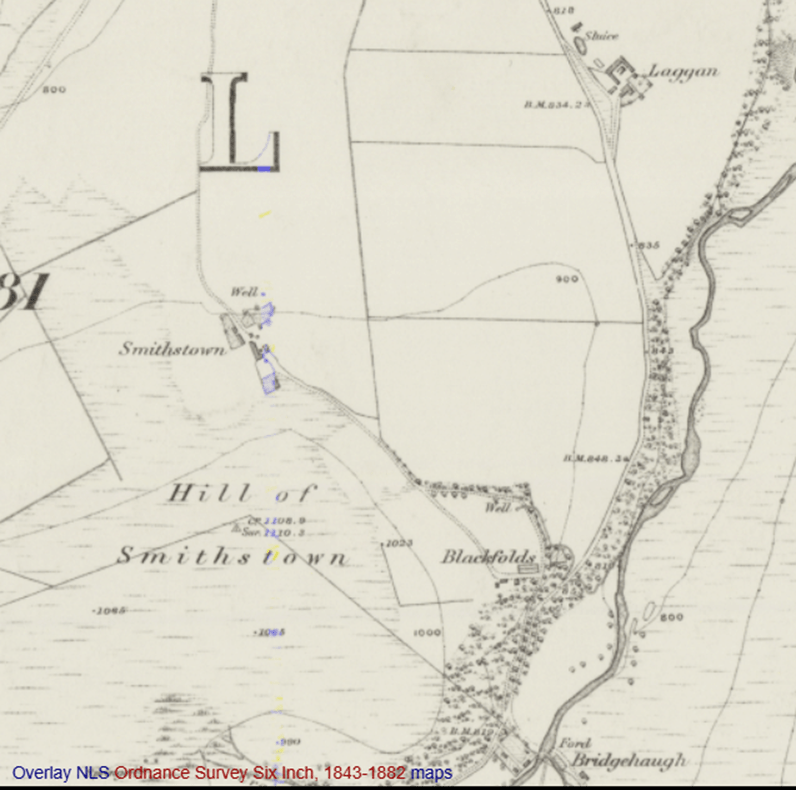
Image from Scottish Places Gazetteer (Ordnance Survey map 1843-1822)
Trial
James and William were initially charged with Deforcing the Officers of Excise.
Monday 26 March 1827, James was brought to the jail of Forfar, charged with deforcing the officers of excise. His name is shown as Garden or Gordon, he possibly had a strong doric accent and his surname was misheard.
Edinburgh lockup House records show that William was transferred from Glasgow on 21 June. James was transferred from Perth on 23 June. They were to stand trial on 16 July at Edinburgh Court of Justiciary.
The trial started on 16 July 1827, where James and William were indited on the charge of ‘Wilfully and maliciously dis-charging loaded firearms, with intent to murder (this charge was laid on the statute 6th Geo. IV. Chap 126) as also obstructing and deforcing officers of the revenue in the execution of their duty, – in so far as on the 6th of February 1827.’
James and William pleaded guilty and after hearing evidence from witnesses, the Lord Advocate found them guilty and they were sentenced to transportation for life.
According to the Edinburgh Lock up Register it notes that they were sent off on 4th September 1827.
Transported
James was transported to Australia on the convict ship Hooghley, which left the UK on 31 October 1827, arriving in New South Wales 24th February 1828.
On 16 March 1835, James was granted permission to marry Rebecca Lucock or Laycock (who came free on the Layton).
In 1844, James was recommended for a conditional discharge, which was recommended on 13 August 1845. This gave him his freedom, but he was unable to leave the colony.
I’m not sure what happened to William, I have not found him on the transportation ship register. It is possible he wasn’t transported but served his time in Scotland.
Sources
- British Newspaper Archive. Inverness Courier, Recent Outrage at Cabrach, 21 February 1827.
- British Newspaper Archive. Aberdeen Press & Journal, 28 March 1827.
- Prison Register, Edinburgh (Lock-up House) Prison, Midlothian, NRS Reference HH21/8/1 p. 16; Index, Scottish Indexes (https://www.scottishindexes.com/prisontranscript.aspx?prisonid=80101614: accessed 17 Apr 2023); Original Source: Prison Registers, National Records of Scotland, Edinburgh, Scotland.
- British Newspaper Archive. Perthshire Courier, The High Court of Justiciary 26 July 1827.
- Ancestry. Australian Convict Transportation Registers – Other Fleets & Ships, 1791-1868. Original data The National Archives.
- Ancestry. New South Wales, Australia, Registers of Convicts’ Applications to Marry, 1826-1851. Original data State Records Authority of New South Wales. Series 12212.
- Ancestry. New South Wales, Australia, Convict Registers of Conditional and Absolute Pardons, 1788-1870. State Records Authority of New South Wales; Kingswood, New South Wales, Australia; Card Index to Letters Received, Colonial Secretary; Reel Number: 782; Roll. Number: 1250
- Whisky Wars Riots and Murder – Crime in the 19th Century Highlands and Islands, Malcolm Archibald. Black and White Publishing Limited, 2013.
 Relatively Family